Thursday, May 31, 2007

Buriganga river in May 2007


View of Bangla-China Friendship bridge 1989 (Buriganga first bridge)

Buriganga view - eastward

Ferry service

Bangladesh Naval Coast Guard Station, Postogola

View of First bridge, Postogola end

Brick collection spot, Hasanabad, south of Buriganga river


Sand collection - large monuments are built at the sweat of these poor people

Luxury liner for group trip


Buriganga-Meghna or Buriganga-Sitalakkhya-Ashulia-Turag trip

Old type boat at Sitalakkhya river, Narayanganj

View of Dhaka from Postogola bridge

View from Badamtali ghat bridge

Paddled Steamer 'Rocket Service' for Dhaka-Khulna route

Sir Salimullah Medical College & Mitford Hospital

Second Buriganga bridge at Badamtali ghat

Bridge beams viewed from bottom

View of Chawkbazar and Lalbagh area (minarets of Chawk Shaheed Masjid and Lalbagh Badshahi Masjid seen)

Buriganga from top of Second bridge

See more on Buriganga river, Dhaka, and
Buriganga river - massive river pollution.

Sunday, May 27, 2007

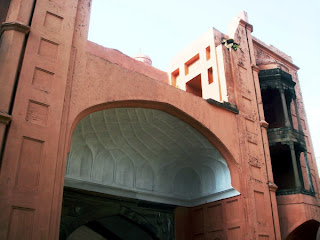
Lalbagh Fort salvaged from neglected past

For history of Lalbagh Fort see:
Lalbagh area and Fort incident, and
Lalbagh Qilla (Fort), Dhaka
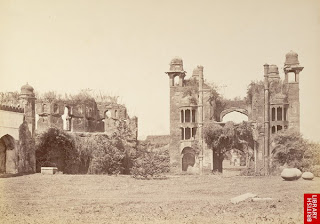

This is how the British rule treated with the Mughal splendor of Bengal (pic 1870)


The look of Lalbagh Fort during 19th century - 100 years after occupation by the British

1874 sketch of Ruined gateway of Lalbagh fort

Viewed by Collector of Dhaka, Charles D'oyle in 1816 AD - his etching of Lalbagh Fort's south west corner from river (Qillar Mor)

view of Lalbagh Fort (photo: johnson and Hoffman 1880s)

Neglected Paribibi's tomb in 1904 (pic Fritz Kapp)

Pic from Banglapedia: Lalbagh Qilla (Fort) sketch reconstructed after excavation by Bangladesh Archeological Dept. (Fort Area: 18 acres). Excavations revealed remains of 26/27 structures with elaborate arrangements for water supply, sewerage, roof gardens, and fountains.

Archeologists after a recent excavation discover continuity of the main fort walls towards east below Shaishta Khan Road and opine that the present area of Qilla only represents half portion as planned by Prince Azam Khan. The gate at south east of Fort (adjacent to Lalbagh Shahi Masjid) as per requirement fits properly as the Central Gate in the middle of Fort, the other half on east- likely palnned for administrative purpose (Girde Qilla area)- were incomplete or extinct long ago.

South west corner (Qillar Mor) - reconstruction and renovation in progress. Narrow lane beside the south wall is Kazi Reazuddin road.

Many elderly still remember this corner as 'riot-er mor' (the junction of riot), the name preferred by the British after crushing the uprising in the fort in 1857 known as the 'first Independence war' (Sipahi bidroho).
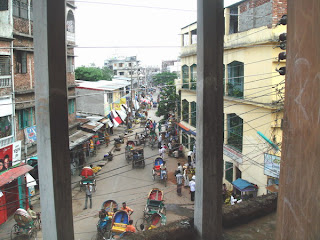
View from south west corner (kiosk) of Fort. The dense area linking 'Kamrangir char' was once part of river Buriganga, where from Charles D'oyle drew his famous etching of Lalbagh Fort in 1816 AD.


Reconstruction of south east corner gate of fort (main gate). Behind stands the Badshahi Masjid of Lalbagh.


Dexterous work of renovation of the south east gate


South east gate (Main gate) then stood at the bank of river Buriganga (now near 'posta')

View of the small north east gate (near Lalbagh road) from the main south east gate of fort

Beauty of a fortress wall from inside
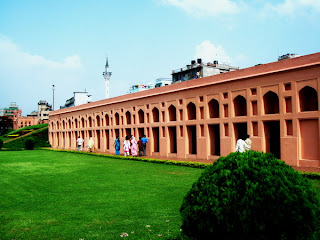
The southern fortification wall upto west end have 5 bastions at regular intervals. The central one contains an underground room (pic below) with verandah on three sides, and it can be approached either from the riverside or from its roof. The double-storeyed bastion at the southwestern corner of the fort was possibly a Hawakhana, with a water reservoir and garden on its roof. Two lines of terracotta pipes were discovered that connected all establishments of the fort with this reservoir. An extra-strong terracotta pipe line made with double pipes, one inside the other, was uncovered in the area between the Hammam (bath house) and Paribibi's tomb.

Fortress wall central entry - viewed from Paribibi's tomb

Fortress wall on west

Area for 'Hawakhana' and garden with water reservoir
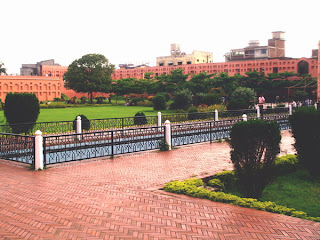
Renovated Fort area - south west. The passage on right goes to Mosque.
The southern fortification is a twin wall, the outer one is about 6.10m high and 1.37m thick, while the inner one is 13.72m high with same thickness. The two are solid up to the height of 6.10m and there are regular openings in the upper part of the inner wall.

View of Mosque and Paribibi's tomb

Paribibi's tomb - south view

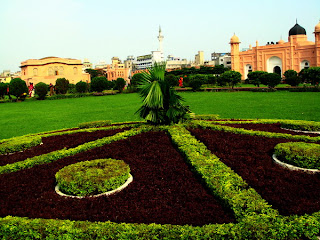
View of Hamman khana (public bath), Paribibi's tomb, Mosque and beautifully laid garden according to original design. Lalbagh Badshahi mosque (Shahi mosque) seen at the rear.
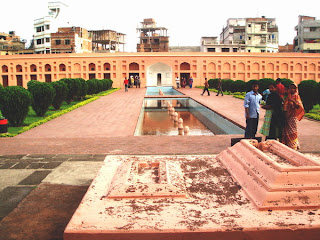
Remains of floral wreaths on the graves south of Paribibi tomb
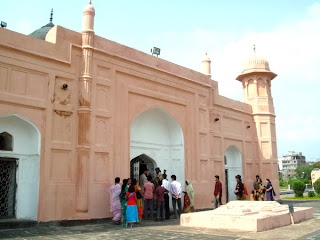
Visitors queing at Paribibi's tomb from south
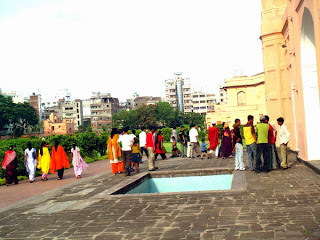
Visitors on the north


White marble wall and jali (marble screen) work inside tomb

White marble Tomb of Paribibi (meaning Fairy lady)- original name said to be "Iran Dukht" was known to be the daughter of Shaista khan, the then Shubahder of Bengal and wife of prince Azam 3rd son of Emperor Aurangzeb.


Diwan-i-Aam (top), and Hammam khana (below) - east of Paribibi's tomb
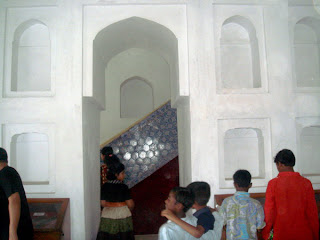
Entry hall to Diwan-i-Aam (Hall of public audience) and Hammam Khana

Hammam (bath) room with water storage, bath tub, kitchen and a oven at one corner
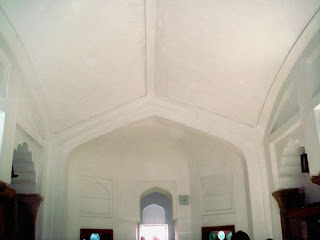
Roof of Diwan-i-Aam (audience hall)

Mughal Cannon on display beside Diwan-i-Aam


Fort Mosque on west: The fort was considered to be a combination of three buildings (the mosque, the tomb of Bibi Pari and the Diwan-i-Aam and Hammam), two gateways and a portion of the partly damaged fortification wall. The underground water line and tank can be seen beside the Mosque.

The smaller gate of fort at north east corner (adjacent to present Lalbagh road)

Shape of an incomplete gate of the Mughal era in the middle of north wall (now the enrtry gate of Fort for visitors).
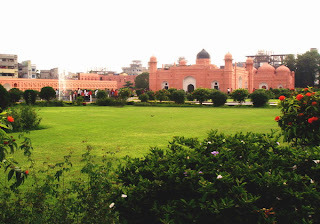


Visitor's delight in the fort

Lalbagh Fort is now under control of Archeological Dept. and open for visitors 6 days a week. Admission to the fort is Tk 5.

A fast-track historical journey back to ancient Dhaka with the 300-year-old Lalbagh Fort in the spotlight is in process through 'Light and Sound' in Bangladesh. According to the proposal, the project is to be completed in three phases. The first phase had been completed in June 2006. The second and third phase will include the main project work and are nearing completion. When completed, the architectural heritage of old Dhaka can be a good source of entertainment for city dwellers, and educational as well.

Friday, May 25, 2007

Sunset sky and clouds of May '07


Sunset over Eskaton

Ramna Atomic Energy Commission

Sonargaon-Panthapath intersection

Sonargaon-Petrobangla on left


Karwanbazar view from Maghbazar

Maghbazar

Cantonment north - Airport Road

Stormy sky, Begunbari-Maghbazar

Cloud breaking in the evening sky, Dhaka 24 may '07


Stormy cloud over Eskaton area

Incomplete structure near Sonargaon-Begunbari intersection

Welders at work for Hilton Hotel, under construction at Maghbazar-Tejgaon Industrial Rd

Thursday, May 24, 2007

Khawaja Shahbaz Mosque & Tomb - a solitary splendor in Ramna


Khwaja Shahbaz Mosque viewed through 'Tin netar mazar' (Three leaders' mausoleum)

Mosque passage adorned with peddlers' clothes

Viewed from west over the roof of 'Tin netar majar'

Khwaja Shahbaz Mosque built in 1679 AD

Mosque courtyard - east view

Persian inscription on year of construction

Central archway of Mosque

Tomb of Haji Khawaja Shahbaz

'Do-chala' (roof with curved eaves) passage room in the south

Tomb of Haji Khawaja Shahbaz- builder of the mosque and the tomb

Khawaja Shahbaz's Mosque and Tomb is located behind the Dhaka High Court, almost hidden by ‘Shishu Academy’ at the south and by the rich sculptural mausoleum of the three leaders (Tin Netar Mazar) at west.

Haji Khawaja Shahbaz, Malik-ul-tujjur or Merchant-Prince of Dhaka, lived in Tongi after he came to this country. During the vice-royalty of Mughal prince Mohammad Azam, he built the mosque and his own tomb structure in 1679 AD in the surrounding of Ramna green. The mosque, featuring ‘Shaista Khani style’ of the three domes on a spacious oblong structure resting upon a raised platform, measures externally 20.73 m by 7.92m. The eastern facade has a projected front in the middle, through which opens out the central doorway fitted with a stone arched frame. It is flanked on either side by a smaller archway.

The tomb of the Merchant-prince on the east of mosque, is a square structure roofed over by a single low dome strengthened with octagonal towers on the four exterior angles. On the south, the hut-shaped structure refers to the typical Bengali 'do-chala' thatched hut type roof that had overwhelming influence during the 17th and 18th century Mughal architecture. The corner towers are extended beyond the horizontal parapets and topped by typical Mughal kiosks. Access to the tomb can be made from each side through four centered arched entrances.

It is also said that Khawaja Shahbaz came all the way from Tongi to the mosque he built in Ramna to say his prayers. He built his tomb before his demise. It seems that so much of his love embraced the mosque that his spirit could not exist without his favorite praying place.

Monday, May 21, 2007

Manik Mia Avenue and around


Birds of different feather exchange greetings

Asad gate (once Ayub gate) in Mohammadpur

Asad Avenue

Asad Avenue-Mirpur road intersection

Street hawker's market, Manik Mia Ave.


Apartments at Manik Mia Avenue (built for NAM conference)


Parliament building changes colour

Traffic jam

Garments girls' tiffin hour (Textile workers)

One posing for photo

Thursday, May 17, 2007

Baridhara to Bashundhara: Res. Area


Cleaning of algae (waterwort) from Baridhara lake

Baridhara park

park pathway


Park: north view

Baridhara park in Diplomatic zone


View of Gulshan-2 from Baridhara park


Lake north


View of United Hospital, Gulshan north


Diplomatic zone road, Baridhara


Embassy bldg

Embassy bldg, Bardhara

Embassy bldg, Baridhara

Nursery, Baridhara


view of Baridhara- north park

Baridhara Apartments

Baridhara apartments, Progoti Sarani/ Biswa Road

Entry passage to Basundhara Residential area, Baridhara


Views of supermarket under construction, Baridhara

Inside Basundhara (Baridhara) Residential area

International School Dhaka at far end

International School Dhaka in Basundhara Res. area

Intl. School Dhaka and part of Apollo hospital, Basundhara R/A

Apollo hospital entry gate

Apollo hospital - west view

Apartments in Basundhara R/A

View from the cabin room of Apollo hospital

Intl. School Dhaka and a Dept store behind

View from inside a Dept. store

International School Dhaka, Basundhara: entry gate

Wednesday, May 16, 2007

Saat Gumbad Masjid, Dhaka


Saat Masjid views

Typical Mughal style courtyard
Plan of Main Mosque (ref: Banglapedia)


Madrassah built too close to Masjid (Mosque)


A picture from British Museum

A sketch of 1874


Saat Masjid: The Seven Domed Mosque (Satgumbad), at the north west outskirt of Dhaka at Jafarabad, was believed to be built around 1680 by Mughal Subehdar Shaista Khan. Bengal was then experiencing an era of grandeur and Dhaka enjoyed the status of a provincial Mughal capital. Saat Masjid in the picture above has 3 central large domes and 4 small domes at 4 corners making the total number of domes to 7.
The Mosque occupies the western end of a slightly raised masonry plinth 26.82m by 25.60m, which is enclosed by a low wall with a gateway in the middle of the eastern side. The mosque proper forms a large rectangle 14.33m by 4.88m on the inside and is emphasised with massive hollow domed towers of octagonal design on the exterior angles. The prayer chamber is entered through arched doorways - three in the east and one each on the north and south sides. Based on the similarity of its design with the Khwaja Ambar's Mosque of Karwan Bazar and the Lalbagh Fort Mosque (1678-79 AD) it is assume to be of 1680 AD, although there is no mention of Shaista Khan (ref: Banglapedia). Prof Muntasir Mamun’s in his book book ‘Dhaka Smriti Bishritir Swahar’ gives the measurement of area as 38’ x 27’ where as, in Dr.Syed Mahmudul Hasan "Dhaka - The City of Mosques", Islamic Foundation Bangladesh, 2002, its area is mentioned as 1500 sft and also acknowledged as of 1680 AD and by Shaista Khan.
This elegant edifice once stood proudly at the bank of Buriganga river against a lush green backdrop of open space. With the advent of British East India Company rule things changed a lot. The area from north of Azimpur were neglected to grow jungles all around the magnificent Mughal structures. Mughal edifices were unpreserved or deliberately destroyed, the old sketches of Dhaka by Charles D’oyle in early 19 th century and others provide ample testimony. In late 20th century, Nawab Ahsanullah made great effort to clean up Jafarabad to restore the mosque. By that time the river had gone far away from the mosque which now stand in a very congested place.

Saturday, May 12, 2007

Crescent Lake in full bloom!

Krishnachura/ Gulmohar: Known as ‘Royal Poinciana’ is a native of Madagascar. It has been described as the most colourful tree and flame of forest. The tree's vivid red/orange flowers and bright green foliage make it an exceptionally striking sight. Every year from April to June the Krishnachura/Gulmohar tree is in full bloom in Bangladesh.

The trees lining along the sides of flamboyant Crescent Lake of Dhaka with the beauty of bright peacock flowers setting the trees on fire is worth a visit.
More on Crescent lake in: Zia-Uddyan and Dhaka City's Waterspots.


Friday, May 11, 2007

View Farmgate to Secretariat, Dhaka


Gulmohar at Sonargaon road, Karwanbazar

Sonargaon road

Flowers - Eskaton Road


Flowers - Dhanmondi lake

Krishnachura (gulmohar) flowers - Saat Masjid Road

Sada Kath Golap (white frangipani) flowers, Viquarunnisa Noon school, New Bailey road

Krishnachura flowers - Ramna

Krishnachura flowers - GPO


Krishnachura covers view of Secretariat bldg

Green mangoes in old circuit house tree, Kakrail

Farmgate park, Tejgaon

Farm gate park

Khamarbari road, Farmgate towards west


Farmgate north view - Airport road

Farmgate south view - Airport road (Kazi Nazrul Islam road)

Tuesday, May 08, 2007

Dhaka BB Stadium: Oldham Athletic Football England lost to Dhaka local Club


Bird's eye view of Bangabandhu Football stadium and Bhasani Hockey stadium, Dhaka

BangaBandhu stadium, Dhaka


Inside renovation and south view

North view - Secretariat and Abdul Ghani road


The young footballers (soccer) of Oldham Athletic, under-20 side from England's century-old club began their campaign today at the newly renovated Bangabandhu stadium Dhaka, with a defeat 1-2 when they met local giants Mohammedan Sporting Club. They arrived in Dhaka yesterday to play three exhibition matches, and will have to deal with a very hot summer during their stay in Bangladesh.

Monday, May 07, 2007

Boat-house, Dhanmondi


View from Sat Masjid road


Pathway for solitude hunters


Perfect place for the recluse

Dhanmondi main Masjid Minaret


'Shorna-lata' creepers rarely viewed in the city

Some more pictures of the Boathouse in:
Dhaka City - by night and Dhaka city's waterspots;

Saturday, May 05, 2007

View around Bangladesh Secretariat, Dhaka


Zero square

Peer Yemeni Mazaar

Once Eden Girls College, later Eden Building, now Bangladesh Secretariat

Secretariat - 9 story south block

South entry gate

Secretariat staff buses

West road - Masjid (Mosque) dome of Secretariat in view

Segunbagicha - old shabby building in front was once the famous "USIS"

Topkhana road, north of Secretariat

Press Club - west of Secretariat

Osmany Memorial Hall - south of Secretariat

Osmany Memorial Hall compound area being taken care of

Railway Head office, Dhaka

Abdul Ghani Road

Colonial bldg - Once Railway hospital, now 40-bed hospital for Govt. employees

Fazlul Huq Muslim Hall - east block

Fazlul Huq Muslim Hall - inside view

Fazlul Huq Hall pond

Extension of Curzon Hall, Dhaka University east

Old High Court South Gate (now Mazaar gate)

Ramna view

Thursday, May 03, 2007

The American lady Balloonist died unsung at Dhaka in 1892


Jeanette Van Tassel, the balloonist

Balloon at some American town in 1880's


Christian cemetery at Narinda, Dhaka


Park Van Tassel's balloon flying exploits began in his hometown of Albuquerque, New Mexico, July 4, 1882. Over the next ten years his team's traveling show took him throughout the western U.S., Hawaii, Australia, and eventually to Dhaka (now in Bangladesh).

In 1892, Jeanette Van Tassel, a daredevil balloonist was flown in from America by Nawab Ahsanullah. During the 19th century, the social life of Dhaka was centered around the Nawab and his family. Unfortunately, the exhibition ended on a tragic note as the adventurous lady met her end during her descent with the balloon.

The Nawabs were famous for their love for entertainment and pageantry. For the benefit of the city dwellers they often organised special events. It was because of one such initiative of the then Nawab of Dhaka, Khwaja Ahsanullah, that this lady was flown in from America on a contract of Tk.10,000/- for the show.

From the newspaper reports of that period and memoirs of Ghaniur Raja, son of illustrious Zamindar and mystical poet Hason Raja of Sunamganj, Sylhet, who was present on the occasion, we learn that the exhibition generated a good deal of enthusiasm among citizens. The area around Ahsan Manzil and Buriganga riverbank was filled with utmost capacity to witness the rare spectacle. People flocked in from all directions, many got into boats in the middle of the river. The Nawab himself, his family members and local and foreign dignitaries witnessed the event from Ahsan Manzil compound.

They would witness the daredevil act of a young American beauty, Jeanette Van Tassel in her late twenties flying by balloon. Tassel had flown by balloon many times before in different countries of the world. She was asked to fly from south of river to north and land on top of Ahsan Manzil.

On 16 March 1892, at 6.20 PM, she started her ascent from the other side of river. Lot of kerosene and wood burnt to inflate the balloon, and soon it looked like a big tent. The balloon would then cast loose from its moorings. The direction of the wind upset her plan to land on the roof of Ahsan Manzil. The balloon rose in the sky swept by a strong current of air and flew passed over Ahsan Manzil. Smoke was visible and Tassel was seen hung perilously. After floating high, tragedy struck on her way down. To the shock of the onlookers, her balloon got enmeshed in a tree at Ramna 2-3 miles away. The police rushed in to rescue. It was reported, that police insisted her to get down holding on to the bamboo pole they placed. The bamboo broke in the middle and Tassel fell on the ground severely injured. She died a couple of days later in a hospital.

She had been married only days ago and her husband, along with many members of Dhaka elite, was present at the spot when a bamboo that was given to her for descending from the treetop, snapped and she crash-landed with grievous injury. It is alleged that her misfortune was the result of police apathy.

As the first instance of flight by Balloon in the then-East Bengal and the following tragedy, the incident created a great commotion at the time and some contemporary newspapers (e.g. the Bengal Gazetteer) gave coverage to it. But in latter years the event was completely forgotten. Her grave exists uncared at the Christian cemetery at Narinda, Dhaka.
(courtesy: The Van Tassel Family History Homepage)

Tuesday, May 01, 2007

May day photos: Dhaka


Rickshaws idle in Paribagh

Boys playing cricket at Begunbari swamp

Lone kite on power line

Boys stroll in Hare road

Tk. 120/- for breaking 100 cft chips

Keeping life line alive


Overloaded truck with waste tyres

Running train stops vehicular traffic at Maghbazar rail crossing

Shallow engine boat in Buriganga river


'Ghugni' and 'Jhal moori' for garment workers

Philosophically peaceful life

Disturbed by flies

Mouth watering sweets in Bismillah stores, Uttora

Bamboo decoration pieces at a Gulshan street

Gulshan lake, south

Twilight at Sonargaon intersection

Flames of Krishnachura (GulMohar) flower

Setting sun over Karwan bazar

End of 30 April, 2007

Moon rise for May 2007