Monday, November 06, 2006

Heritage: Sonargaon to Panam Nagar!


Sonargaon ruins

Dulalpur bridge

Sonargaon (Panam Nagar) ruins

Bangla bari

Sonakanda fort

Tomb of Sultan Gyasuddin Azam Shah

Sonargaon Museum

Kadam Rasul dargah at Nabiganj
(pics: unknown websites)
Sonargaon (literal meaning ‘golden village’) was the capital of eastern Bengal under the Shahi Sultan rulers of Bengal during medieval age. It survives at present as a township about 27 kilometers southeast of Dhaka. It’s difficult to locate exactly the medieval city, but from the old remains it appears to encompass a wide tract bounded on the east, west and south by the Meghna, the Shitalakhya and the Dhaleshwari rivers respectively and on the north by the Brahmaputra.

With the annexation of the Muslim principality of Lakhnauti by Shamsuddin Firuz Shah in 14th century, Sonargaon became the seat of an independent ruler under son and successor Ghiyasuddin Bahadur Shah, and after his fall it became the headquarters of the eastern province of Bengal under the Tughlaqs till 1338. Sonargaon emerged as the capital of an independent Sultanate under Fakhruddin Mubarak Shah (1338-1349) and his son Ikhtiyaruddin Ghazi Shah (1349-1352).

By the second quarter of the 14th century, Sonargaon developed into a commercial metropolis. Seafaring boats reached Sonargaon from west Asian and southeast Asian countries. Ibn Batuta describes Sonargaon as an important port city which had direct commercial relations with countries like China, Indonesia (Java) and the Maldives. The Chinese envoy Hou hien (1415) describes it as a fortified walled city with tanks, streets and bazaars. Famous Muslin produced in Sonargaon, especially its finest variety called khasa, had a worldwide reputation.

Sonargaon developed into a seat of Islamic learning under the versatile scholar Maulana Sharfuddin Abu Tawwamah of Bokhara who came between 1282 and 1287. He established a khanqah and a madrasa wherein all branches of Islamic learning as well as secular sciences were taught and studied.

With the advent of the Mughals and establishment of capital at Dhaka, Sonargaon is thought to have fallen fast into decay. In the late nineteenth and early twentieth century Panam-Nagar was developed as a part of medieval Sonargaon. With the loss of political status in the second decade of the 17th century, Sonargaon gradually lost its commercial importance as well.

The existing remains now are a few medieval buildings, mostly religious, belonging to the Sultanate and Mughal periods, some Mughal bridges and a few residential buildings of the colonial period. The other remains are Sultan Ghiyasuddin Azam Shah’s Tomb at Shah Chilapur, Paanch Pir Dargah and Mosque at Bhagalpur, Sonakanda fort (17th century), Dewanbagh mosque (16th century) at Dewanbagh, and Kadam Rasul (1778-79) at Nabiganj.

Also see, Panam nagar and Sonargaon.

Churches of Dhaka


Gate of Church, old and new church (below)


Holy Rosary Church Dhaka: In the heart of Dhaka, on a vast area of land in Tejgaon that was allowed by the the then Mughal Subahder, stands the old building of the Holy Rosary Church, a parish cultivated by the Holy Cross Fathers and Sisters. It is believed to be the oldest church in the Indian sub-continent once known as 'The mother of Churches.' The inscription on the pinnacle of the old Church shows a date numerals 1677, built by the Portuguese Augustinian missionaries but many believe it was built in the 16th century. (In 1628, they established a church, called the ‘Church of the Assumption’, in Narinda, southern part of the Dhaka city. But the church doesn't exist this days). So this church is popularly known to be the oldest church of the city. In 1610, when Dhaka became the Mughal capital of Bengal, European and central Asian settlers came in numbers and built factories in Tejgaon area and later in old Dhaka and Farashganj. Traveler Sebastian Manrique and Travernier visiting Dhaka in the 17th century mentioned the church in their journals. The church measured 210' x 32' x 25' high built with brick and lime-surki on 12 massive columns depicting 12 disciples of Jesus. It had congregation capacity of 800-900.

In the early years of 17th century the Nestorian Christians built the western part as a chapel. The walls are 48 inch thick in this part. The eastern part is 83 feet and 6 inch long and 32 feet and 3 inch wide,the walls are 15 inch wide. There are 12 Tuscan columns holding the central nave from both side. The diameter of the columns is 3 feet. The church contains all the signs of a Basilican church . It has a main long rectangular hall consisting central nave and aisles in both side. It features Hindu, Muslim, Christian and regional architecture style. The church has 5 entries main entry is on east facade and the north and south facade has 2 entries each. The south and northern entries lack any porch. The north and south facade have 9 windows each.

The new church built recently is a large one covers 17,000 sft area and 50' high (91' dome height). It accommodate 1500 plus 500 in veranda. The architecture depicts sea shell in beach (baptism) and 3 slant roof (trinity) following local style.

The Holy Rosary Church premises houses one of the two Catholic cemeteries in Dhaka. More and more Catholics in the new part of Dhaka are buried here. Two schools belonged to this parish, Holy Cross College for the girls and Notrè Dame College for the boys.


Archbishop's House, Kakrail Dhaka: established in 1886 at 1 Kakrail Road, P.O. Box-3, Dhaka 1000, Bangladesh.
Baptist Church Sangha, Sadarghat

Hostel, Liaqat Av. Sadarghat
St. Thomas Church, Dhaka: The official name of this Anglican Church, better known as the St. Thomas Church, is the 'Church of Bangladesh'. Built in 1819, and consecrated two years later by Bishop Reginald Heber of Kolkata (Calcutta), the church premise was in an area of lush greeneries with the famous Bahadur Shah park in a stones throw distance on the south. The north-south axial Nawabpur/Johnson Road, the most important commercial street connecting the old part of the city with the new, was on the west and separated the area from the court, Bank, DC's office and Jagannath College buildings across it. In fact the church overlooking the greens was a major focal of the city centre in the nineteenth century.


It is said that the convicts from Dhaka Jail gave their labour to build this church as well. The attraction of this building, built after the style of the prevalent contemporary Indian Churches, is a clock tower. The rectangular flat-roof steeple rises above the roof in two stages. The arches over the doorway and windows are of Gothic style, while those of the main tower are pointed. The roof used wooden battens on iron joists; the floor have tiles. The delicate stone and brick works of this white plastered building are still as immaculate as it has been for nearly two centuries.


St. Gregory's Church, Laxmibazaar: Located opposite to the old Municipality Office at Laxmibazaar, this church was built in different stages. The original church of the order of the Holy Cross was erected in 1897 probably by a Belgian Father Gregory the Great. It was in French-Gothic style. But the original building collapsed in an earthquake that ravaged Bengal. Afterwards, it was rebuilt, converting the large back verandah into the main prayer hall. The church building, adjacent to the missionary school by the same name, has seven entrances on the west, each one crowned by Gothic arches and coloured glass skylights. The porch on the north-west corner carries a square belfry originally fitted with a clock.


The Armenian Church, Dhaka: The Armenian Church is a historically significant architectural monument situated in the Armanitola area of old Dhaka, Bangladesh. It was established by the Armenian community, to whose former existence the church bears testimony. It is one of the oldest constructions in this city and was built in 1781. The Armenians were rich influential business community. Armenian traders came to the Indian subcontinent in 12th century. After their ample success in trade, Mughal Emperor Akbar permitted them to preach. The area where they lived became known as Armanitola. The Armenian Church in old Dhaka was one of the meeting places for the orthodox Armenian Christians, who observe Christmas on January 7. In the mid-19th century, they numbered no more than about 40 families. Because of their close business ties with the British East India Company, many Armenians became rich 'zamindars' with palatial houses. The church in Armanitola, in the heart of the crowded old city is known an oasis of tranquility. Twice a year the Armenian Archbishop from Australia comes here to hold ceremonies. Mother Teresa during her visit to Dhaka in 1996, stayed in this compound. The Church has a chapel with a balcony and the original wooden seat for 100 people. The ground cover nearly a hectare and is paved with 350 old graves stones, some quite ornately carved. Judging by the ages of those buried here, it seems that the local climate suit the Armenians.

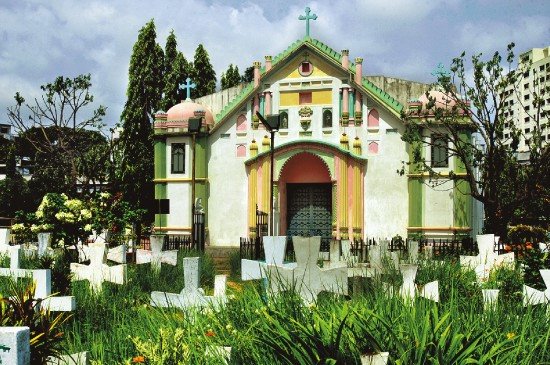
Note: (Christian Cemetery at Narinda, Dhaka)

Sunday, November 05, 2006

Dhaka through the ages...


Sikh Gurdwara Dhaka: Gurdwara Nanak Shahi, the main Sikh Gurdwara in Bangladesh, is situated in the campus of the Dhaka University near the arts faculty building. At one time it was known as 'Sujatpur Sikh Sangat', as it was situated in what was then Sujatpur mouza. It is believed to have been built at the initiative of a Sikh priest sent by the sixth Sikh guru, Hargobind Singh (1595-1644), during the reign of Emperor Jahangir. Some others believe it was built by the ninth Sikh guru, Teg Bahadur Singh (1621-75).


Dhakeswari Mandir: It's a Hindu temple, said to be built in the 11th century in old Dhaka Lalbagh area. This is considered the oldest and most prominent of the Hindu temples built in Bangladesh through the ages. The photo of temple at right was taken by Fritz Kapp in 1904 while the left picture is what it looks now. The pond shown in the old picture no longer exists.


Saat Masjid Dhaka: The seven-domed mosque (Satgumbad) was built at the north west outskirt of Dhaka. Now it is very much in the centre of city. The sketch of the Saat Masjid drawn by the British collector dates 1874.

Chawk Mosque (Dhaka):
Located in the Chawkbazar area of old Dhaka, the mosque has been altered and extended so much that today it is hardly possible to have an idea of its original form and design (to compare see the photo post below with Bibi Mariam cannon). The western half of the 3.05m high vaulted platform (28.65m from north to south and 24.38m from east to west) is occupied by the original three-domed mosque proper. The vaulted rooms underneath the platform must have been originally devised for providing residential accommodation for students and teachers. Multi-storied extensions have been made on the north and east sides. The original three-domed roof has been demolished and a new one of similar nature (with a bigger central dome) is built over the upper storey. This is perhaps the earliest dated mosque in Bengal that was built on a high vaulted platform. A Persian inscription over the central doorway of the mosque proper records its construction by Subahdar Shaista Khan in 1676 AD.

Mir Jumla’s great Cannon: “Bibi Mariam”


Pic 1: Photo taken in 1880 AD, Bibi Mariam cannon shifted from Swarighat to Chawkbazar, Dhaka


Swarighat- where cannon 'Bibi Mariam' was first laid by Subehdar Mir Jumla to ward off attacks by Magh and Arakan pirates - New Minaret of Chawkbazar Masjid visible behind, Barakatra almost extanct.

Pic 2: Cannon shifted from Sadarghat to DIT Avenue in 1957, DIT building and clock tower seen in the background

Pic 3: Osmani Uddyan at Ramna (old railway land), Dhaka opposite to City Corporation Ofiice


Pic 4: Bibi Mariam in Osmani Uddyan - resting place


The massive 17'-3" long cannon seated at the entrance of Osmani Uddyan, Ramna, Dhaka is known as Dhakar Kaman/Sadarghater Kaman. Mir Jumla II (Mir Muhammad Said of Ispahan), the Mughal Subahdar (Governor) of Bengal in Dhaka (1660-1663) added two massive cannons to his armory namely Bibi Mariam and Kale Jamjam or Kale Khan. It is however not known as to exact date when these cannons were commissioned. Charles D'Oyly who was Collector of Dhaka between 1808 and 1811 believed that the cannons were built in Dhaka in the 17th century by local technicians under the guidance of Mughal engineers, as it was unlikely to move such heavy cannons on waterway from capital thousand miles away. 

Mir Jumla placed "Bibi Mariam" and "Kale Jamjam/Kale Khan" on both sides of Buriganga river- one in Swarighat in front of 'Barakatra' and the other on a sandbar near Jinjira- to defend Dhaka's waterfront from frequent attacks of the Mogh and Arakan pirates. Mir Jumla at the time of his conquest of Assam took these cannons to recover the erstwhile Mughal territory in Kamrup and invaded the Ahom kingdom in January 1662 and left it in January–February 1663. He was able to occupy Garhgaon, the Ahom capital.

After the fall of Mughal power and Nawabs of Bengal, during occupation of Bengal by the British raj in the 18th century, Kale Jamjam was devoured by river Buriganga (local people believed Kale jamjam came from heaven so went away, they revered the place till it was vanished.). Robert Lindsay, an young officer of the East India Company who visited Dhaka in 1776 saw these two cannons and mentioned them as Dhaka's main attraction despite Lalbagh Fort and the Katras. He blamed the authority for neglect and loss of cannon Kale jamjam in 1780. James Renell, the famous oceanographer who was posted at Dhaka in the later half of 18th century described Kale Jamjam as prominent and gorgeous of the two. Both of them measured the cannon Kale Jamjam in different times and the measurements were also identical except the length of cannon. Lindsay mentioned cannon as 36' long built on 14 pieces wrought iron tubes joined together with 3" thick iron rings, smothly hammered and finished, whereas, Renell mentioned the length as 22'-10" built with 12 iron tubes only. Maximum outer dia near rear of cannon was 3'-3" with 1'-3" barrel caliber (inside dia). Weight of cannon was 64,814 lbs capable of launching cannon balls of 1200 lbs each.

 In 1832, British Collector Mr. Walter salvaged Bibi Mariam from falling into river at Swarighat and placed at Chawkbazar, the main square. The photo (pic 1) of the cannon Bibi Mariam at Chawkbazar was taken by Johnston and Hoffman in 1880 . Bibi Mariam is 17’-6” long,  maximum outer diameter at rear is 2’-2” and at mouth 2-6” with 6"dia. barrel hole (inside dia).

In 1917, the director of National Museum of Dhaka made an attempt to shift the cannon from Chawkbazar, and at a later stage it was installed at Sadarghat river bank on masonry platform. Local people, especially the Hindu women used to pay tribute to this cannon by offering milk, flowers and vermilion (sindur) daily on the belief that fueled the practice of treating the cannon as an icon of power. After partition of India, in 1957, Dhaka Improvement Trust with the aid of Army engineers moved the cannon to crown the road junction of new DIT Avenue and Jinnah Avenue (now Bangabandhu Avenue) facing Gulistan cinema (pic 2). In late ‘80s the place became too crowded and the cannon was shifted to its present site in Osmani Uddyan (pic 3-4).

"Kale Jamjam" was sunk by river erosion somewhere between Swarighat and Jinjira. It is said with a hint of superstition that a roar is often heard by the neighbouhood coming from the direction of the river for its partner Bibi Mariam.

Also see Mir Jumla Gate (Ramna Gate).
Sadarghater Kamam

Friday, November 03, 2006

Dhaka: Moghul town to Metropolis


Dhaka city view

Dhanmandi Res Area

Sheraton hotel

Shahbagh crossing view

Dhaka (Dacca), the capital of Bangladesh is situated on the bank of Buriganga River, a channel of Dhaleswari at 23°7 N, 90°375 E. With a population exceeding 12 million, Dhaka is the largest city in Bangladesh and amongst the largest in the world.

Dhaka's history dates back beyond 1000 AD. The Buddhist kingdom of Kamarupa ruled the city area. In mid-12th century when the Buddhist Pala dynasty of Bengal was overthrown by the Sena kings, who were orthodox Hindu Brahmins. Sena kings followed a policy of persecution of Buddhists, the dominant population, and drove them towards east.

During 11th to 13th centuries Islamic Sufi spiritualism attracted the Buddhist and the persecuted masses of Bengal to embrace Islam in greater number.

After the fall of the Sena dynasty by the invading Turks from west in the early 13th century and later by the Afghans, various parts of Bengal were consolidated and brought under a semi-independent Sultanate with the capital first at Gaur and then at Sonargaon 15 miles east of Dhaka. From this period the region received a continuous flow of Muslim immigrants from various parts of India. These immigrants led great land reclamation schemes of southern Bengal and a few other non-settled areas, which continued for several centuries.

Dhaka was successively ruled by the Turkish and Afghan governors descending from the Delhi Sultanate before the arrival of the Mughals in 1608. At that time Dhaka consisted of a few markets and localities of craftsmen and businessmen. The Afghan Fort in Dhaka was located at the present Central Jail near Chawkbazar.

The city achieved its glory of as capital of Bengal Province under Mughal rule in 1608. With the growth in population, public works and township began to expand. Subedar Islam Khan became the first viceroy administrator and the city was named "Jahangir Nagar" (City of Jahangir) after the Mughal emperor Jahangir. The greatest expansion of the city took place under Mughal general Shaista Khan (1662-1677 and 1679-1689). The city then stretched for 12 miles in length and 8 miles in breadth along the river and is believed to have had a population of nearly a million people.

The British East India Company took control of Bengal in 1765 after the Battle of Plassey. Owing to the war, Dhaka’s population shrank dramatically in a short period of time and its importance declined. Dhaka had a strategic link to the frontier of the northeast Indian states of Tripura and Assam. The British rulers began its development in the late 19th century. They built public works, educational buildings and a cantonment on north of the town. During World War II, the city served as important strategic military and supply base for the British Army to engage in the defense of Burma from Japanese attack..

After the independence gained by India and Pakistan through partition in 1947, Dhaka became the capital of Eastern part of Pakistan. In 1971 following a bloody civil war, East Pakistan became an independent State- ‘Bangladesh’ with Dhaka as its capital.

Bangladesh with population over 140 million has the third largest and most homogeneous population in south and Southeast Asia, and the eighth largest population in the world. About three-fourths of its population are rural, two-thirds agricultural, and more than 85% are Muslims. About 99% of the population speak in Bangla.

Lalbagh Qilla (Fort) DHAKA


Ruins of Lalbagh Fort in 1870
during British rule

Renovation of fort area

Fort renovated

Bastion of Lalbagh fort
an etching drawn by Sir Charles D'oyly'e in 1816

Bastion on south

Gate south east of fort


Lalbagh Fort is an incomplete Mughal palace fortress in Dhaka on the river Buriganga in the southwestern part of the old city. The river has now gone further south.

Prince Mohammad Azam son of emperor Aurangzeb during his Vice-royalty of Bengal laid the foundation of Lalbagh fort and commenced its construction in 1678 AD, but before he could complete, he was recalled by emperor Aurangzeb. His successor, Shaista Khan did not continue the work, though he stayed in Dhaka up to 1688. His daughter Pari Bibi (meaning Lady Fairy) also known as Iran Dukht wife of prince Azam died here in 1684 and this led him to consider the fort to be ominous.

For long the fort was considered to be a combination of three buildings (the mosque, the tomb of Pari Bibi and the Diwan-i-Aam), two gateways and a portion of the partly damaged fortification wall. But recent excavations by Dept of Archaeology revealed existence of other structures.

The southern fortification wall has a huge bastion in the southwestern corner. On the north of south fortification wall were the utility buildings, stable, adm block, and its western part accommodated a beautiful roof-garden with arrangements for fountains and a water reservoir. The residential part was located on the east of the west fortification wall, mainly to the south-west of the mosque.

Fortification wall on the south had 5 bastions at regular intervals two story height and the western wall had 2 bastions, the biggest one is near the main southern gate. The bastion had an underground tunnel.

The central area of the fort is occupied by three buildings - the Diwan-i-Aam and the Hammam on its east, the Mosque on the west and the Tomb of Pari Bibi in between the two - in one line, but not at equal distance. A water channel with fountains at regular interval connect the three buildings from east to west and north to south.

The water channels and the fountains, are very common features of Mughal architecture. A big square water tank is placed to the east of the Diwan-i-Aam.

The Lalbagh Fort Mosque is a beautiful three-domed mosque with a water tank for ablution.

The double storeyed Diwan-i-Aam is attached with a single storeyed Hammam on its west. The Hummam complex includes an open platform, a small kitchen, an oven, water storage area, a masonry brick bath-tub, a toilet, a dressing room and an extra room. The Hammam portion has an underground room for boiling water and a passage for sweepers.

The Tomb of Pari Bibi is the most impressive of the surviving buildings of the fort. Eight rooms surround a central square room, containing the mortal remains of Pari Bibi, which is covered by a false dome, octagonal in shape, and wrapped by brass plate. The entire inner wall of the central room was covered with white marble,

"Sir Charles D'Oyly (1781-1885)" who worked as a Collector of Dhaka during 1808-1811 published a book of his collection of sketches "The antiquities of Dacca". The publisher in London did something more than simply provide the story of Dhaka as narrated by Charles D’Oyly. They furnished a list of all the collectors who worked in the city before and after the arrival of the writer-artist, right up to 1857, the year when the Sepoy Mutiny in India occurred. It is the sketches that draw the reader’s attention. Clearly, the arrival of the English had led swiftly to a deterioration in the aesthetic charms that had given the city, in Mughal times, a distinctive appearance. It was these remnants of past grandeur that D’Oyly drew faithfully on his canvas before carrying them along with him to London to publish. Such images of Dhaka as the Hussaini Dalan, Chawkbazaar, Barokatra, Lalbagh Fort and Tongi Bridge jolt people back into an awareness of the history their ancestors have lived through. One might then suggest that a very remarkable contribution that the work makes in these times is to rekindle a sense of history in the present-day generation of Bengalis.

Also see Lalbagh Area and Fort Incident and
Lalbagh Fort salvaged from neglected past.

Thursday, November 02, 2006

Parliament Building SB Nagar Dhaka


Top Left: MP Hostel for Parliament; Top Right: Parliament building East View
Bottom Left: Parliament Building Interior; Bottom Right: MP Hostel


-a place of calm from which action comes-- National Parliament Building Complex at SB Nagar Dhaka designed by the celebrated architect Louis I Kahn.

Wednesday, November 01, 2006

Traffic


Traffic jam has been an integral part of life in Dhaka city for long. View of Mohakhali flyover in the new Dhaka area. (Pic: unknown website)